A dog scared of fireworks and a dog scared of thunderstorms look the same at 11pm: panting, pacing, trying to get under the bed or over the wall. They are not the same problem. Fireworks come on dates you can circle, Diwali on 8 November this year and New Year's Eve. Highveld and KwaZulu-Natal storms come most afternoons from October to March with no warning you can act on. The fixes overlap; the planning does not.
This post is for the owner who has done one bad New Year's Eve and does not want another: what to do on the night, what the by-laws say in five metros, a six-week desensitisation plan, what to ask the vet, and what to do if your dog bolts.
Fireworks vs thunderstorms: why they're different
Noise fear is common and under-reported. In a University of Bristol study published in Applied Animal Behaviour Science in 2013, about a quarter of owners described their dog as fearful of noises, but in detailed interviews almost half reported at least one typical fear behaviour in response to noise. Fireworks were the most common trigger, with thunder and gunshots the other main ones, and fewer than a third of those owners had asked a professional for help.
Fireworks: predictable dates, unpredictable neighbours
The calendar is on your side: Diwali and New Year's Eve are the two nights that matter in South Africa. The RSPCA puts fireworks at 120 to 175 decibels, and a dog's ears are more sensitive than yours, so "a few crackers down the road" is a bigger event on your stoep.
What you cannot predict is the neighbour who starts at 7pm on 30 December. The laws are not often enforced, and as one 2022 report on the NSPCA's fireworks plea put it, many animals spend "a total of two weeks living in terror" each season. Plan for the window, not the night.
Highveld and KZN storms: pressure, static, no warning
A storm-phobic dog often starts shaking before you hear anything. Veterinary behaviourists note that thunderstorm phobia spreads: a dog that began by fearing thunder ends up reacting to rain, wind and the air-pressure change that arrives ahead of a Highveld storm, which is why the dog is in the bath while you are still looking at blue sky.
That matters for treatment: a recording covers the bang but not the pressure, the flash or the smell of rain, which is why the same reference notes that sound exposure alone seldom fully resolves storm phobias.
Signs of noise sensitivity
Pacing, panting with the mouth pulled back, trembling, drooling, hiding in the bath, pressing against you, whining, refusing food, and the big one: trying to escape. The Bristol study lists vocalising, trembling, hiding and seeking out people as the most common signs.
On the night: what to do
The den: where, what, and why not the garage
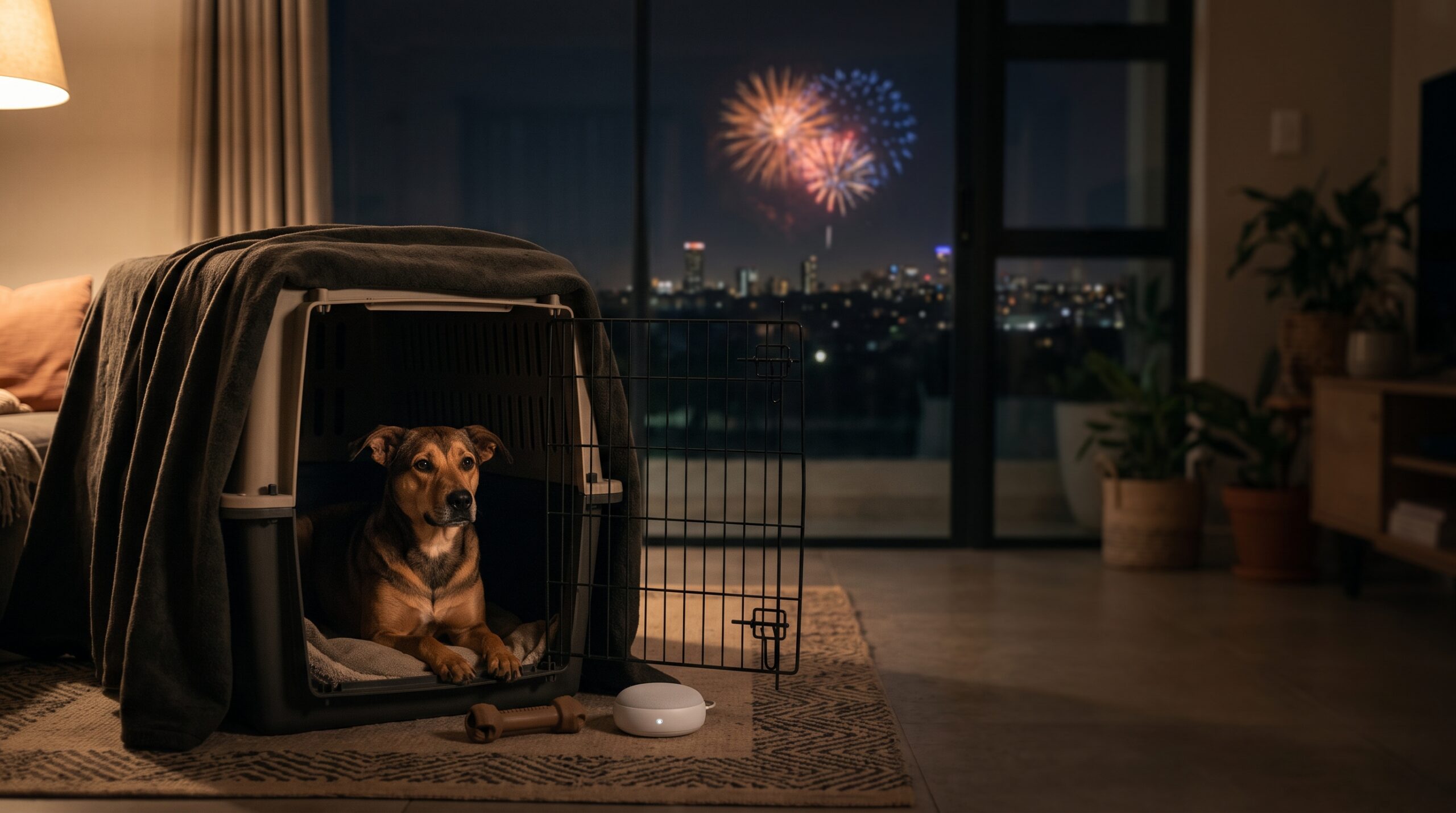
Pick the quietest interior room, ideally with no wall facing the street: a passage, a walk-in cupboard, a bathroom. Put the dog's bed in it with a worn T-shirt of yours and a favourite chew, and feed treats there for weeks beforehand: the MSD Veterinary Manual's advice is to build the positive associations in advance and take the dog there before the noise starts, not after.
Not the garage: the metal door rattles with every bang, the floor is hard, and there is usually a gap a panicking dog will try to get under. Not the garden either.
Sound masking and closing curtains
Close the windows and curtains so the flashes disappear and the sound drops, then run something steady: a fan, the TV, a radio, a white-noise track on a phone. The RSPCA advises blocking the flashes out of the safe area entirely if you can.
Stay calm, stay home, don't punish, don't force
Be there. Behave normally, sit near the den, and if the dog wants to press against you, let it. Comforting a frightened dog does not reward fear. Do not drag the dog out of the bath to prove there is nothing to fear: punishment makes the dog afraid of you as well as the noise, and forced exposure (flooding) can make the phobia worse.
Walk early, feed early, toilet before dark
On Diwali and 31 December, walk long in the afternoon so the dog is tired, feed early, and get the last toilet break done before sunset. After dark the dog goes out on a lead only, even in your own garden, even if it has never jumped the wall. Those are exactly the dogs the SPCA picks up on 1 January.
Double-check gates, collars and tags
Walk the perimeter in daylight: gate latches, the gap behind the Wendy house, the loose palisade panel, the gate motor that sits open during load shedding. Then the collar: snug enough that it cannot slip over the head when the dog backs away, with a tag carrying two phone numbers. If the dog is inside for the night, the collar stays on.
When fireworks are legal in your city
The Explosives Act sets the national floor (no fireworks in a building or public road, nobody under 16 without an adult) and each metro layers its own by-law on top. They differ widely: Cape Town allows no backyard fireworks at all, Johannesburg allows them on eleven listed days, eThekwini gives you 30 minutes at New Year. The table is checked against each municipality's own by-law, notice or spokesperson statement as at October 2026; confirm the current year's notice before you rely on it.
A six-week desensitisation plan
Desensitisation means playing the scary sound so quietly the dog does not react, pairing it with something good (counter-conditioning), and creeping the volume up over weeks. The plan follows MSD Veterinary Manual and RSPCA principles: start below the dog's threshold, raise intensity only while the dog stays relaxed, vary the volume up and down with an overall upward trend, and never push through a reaction. Six weeks is a minimum. Start this week and you will not be ready for Diwali on 8 November, but you can be for New Year's Eve.
You need a fireworks or thunderstorm recording (free on YouTube or Spotify), a speaker that turns down to almost nothing, and the dog's dinner or high-value treats. Short sessions of five to ten minutes, a few times a day, beat one long one.
Week 1: find the starting volume
Play the track at the lowest volume the speaker manages, in the room the dog is most relaxed in. Watch ears, mouth and tail. If the dog carries on eating or dozing, that is your starting volume. If it stiffens, looks at the speaker or leaves, go lower: move the speaker to the next room or put it behind a cushion. Stay at this volume all week. It will feel pointless. It is not.
Week 2: pair the sound with food
Same volume. Now the track plays only while dinner is being eaten, treats are being hand-fed, or a game is on. Sound on, food appears; sound off, food stops. You are teaching the dog that bangs predict chicken. Three or four short sessions a day, each ending before the dog loses interest.
Week 3: raise the volume
Go up one notch and repeat week 2. Check body language before every further notch; if the dog reacts, drop back two notches for two days. A session at notch 4, then notch 2, then notch 5 teaches more than 2, 3, 4, 5, because real fireworks are not neatly graded either.
Week 4: add flashes
Fireworks are light and sound; storms are light, sound and rain. Hold the volume where week 3 ended and start flicking a lamp on and off during sessions, then a phone torch against the curtain. For storm dogs, run a hosepipe on the roof or windows during a session. Each new element starts back at a lower volume.
Week 5: generalise to other rooms
Move the speaker to the passage, the kitchen, then outside the window, so the sound comes from the direction real fireworks will. Repeat the pairing in the den room, so room, sound and food link up. Add a session at dusk, because that is when the real thing starts.
Week 6 onward: maintenance
Once the dog eats happily through a moderately loud track, drop to two or three sessions a week through the season. Note the volume the dog tolerated; next year you start there. If the dog will not eat, the volume is too high, and if that keeps happening at the lowest volume you can produce, it is a vet conversation, not a training one.
Calming aids and vet options
Pheromone diffusers, pressure wraps and calming treats all exist, with evidence ranging from reasonable to none. We grade what is sold in South Africa in our post on calming aids for dogs, so the table is not repeated here.
For a dog that panics, the vet is the right call. Book in October for Diwali and early December for New Year, because every vet in the country has the same conversation in the same fortnight. You are asking about situational medication, given before a known event. The MSD Veterinary Manual describes dexmedetomidine oromucosal gel (sold as Sileo in some markets) as approved for canine noise aversion in the United States, with a fast onset and short action suited to predictable events, and trazodone as a slower option that takes 90 to 120 minutes to work and lasts roughly four to six hours. Benzodiazepines are used with caution. For a storm dog facing a whole season, a daily anti-anxiety medication such as fluoxetine may be discussed alongside the situational one.
Ask what is registered and available in South Africa, how long before the first bang to give it, and whether a trial dose on a quiet evening makes sense. Do not sedate a dog with anything you have at home or a leftover script from another dog. Medication is a bridge for the night, not a replacement for the training above.
If your dog bolts
A frightened dog goes further and faster than a lost one. The Cape of Good Hope SPCA's spokesperson Belinda Abraham put it plainly after New Year 2025: terrified animals "can travel far from home, and may have hidden in tight spaces, unable to free themselves". Do the "before" list now, in October.
Before: microchip registered and current, ID tag with two numbers, recent photo
A microchip is only as good as the database entry behind it. Log in to whichever registry your vet used (Identipet and GetMeKnown are both South African online registries) and check that the chip number, your cell number and your address are current. Then a flat tag with two phone numbers, yours and someone who will answer at 1am, and a clear, recent photo of the dog on your phone.
The NSPCA's advice is the same: microchip, plus a collar tag with your details, and be ready to show proof of ownership when you collect. Our dog GPS tracker guide covers the one accessory that turns a search into a map; for a dog with a bolting history it is money well spent.
After: SPCA and welfare contacts, community groups, vets, the first days
Start the same night. Walk the immediate streets calling in a normal voice; a shouted, panicked voice sounds like more danger. Leave the gate open with the dog's bed and water inside it. Post a photo and your number to the suburb WhatsApp and Facebook groups, which find a lot of dogs before any official channel does. At first light phone your SPCA, then go in person with the photo and proof of ownership, and go back every day: intake on 1 January is chaotic. Phone the vets within a few kilometres, since injured dogs go to the nearest one, and the welfare groups that are not the SPCA, because a dog picked up by a private rescuer may never reach the SPCA's register. In Cape Town the SPCA's number is 021 700 4158.
The scale of the problem
The numbers from this past New Year are worth sitting with. In Buffalo City, nearly 40 displaced dogs were brought to SPCA facilities after the fireworks. East London SPCA took in 30 animals on 31 December and 1 January; its general manager Brent Sanders said most were traumatised and "would jump fences to try and hide". Qonce SPCA logged 26 missing-dog cases on New Year's night, kept eight at its kennels, and a week later only three had been claimed. Its manager Annette Rademeyer called it "probably the worst Christmas we've had in the last 10 years".
Long-term: when to see a behaviourist
Go when the fear is spreading, when the dog reacts to rain or a slammed door as if it were a storm, when it has hurt itself or escaped, or when six weeks of the plan above has moved nothing. Storm phobia rarely resolves with sound work alone, and a veterinary behaviourist can combine a tailored programme with medication in a way a trainer cannot. The route is through your vet, who can rule out pain (a sore dog is a jumpy dog) and refer you. Our post on dog training courses in South Africa explains the difference between a trainer and a behaviourist. You want the second one, working reward-based, because adding fear to a fearful dog makes this worse.
The Last Bark
Fireworks are a calendar problem and storms are a season problem. For both: a den built in advance, curtains closed, a steady noise on, you at home and calm, an early walk and a lead after dark. For fireworks, know your city's by-law so you can call it in, and start the desensitisation plan early enough to matter for New Year. For storms, get the vet involved before the season, not at the end of it. Our Christmas gift guide for dogs covers ID tags and a basic calming kit for the holiday weeks.
The cheapest insurance is a microchip with your current number behind it and a tag with two numbers on it, checked this week. The new puppy checklist covers chipping and ID from day one, and for Highveld storm season our winter dog care guide has the region-by-region seasonal notes to plan around.